How to Stand Out at Cityscape Egypt: A Design Guide
Exhibiting at Cityscape Egypt? Hashtag10 designs and builds custom exhibition stands for real estate brands at EIEC Cairo, from 3D concept to on-site installation. Request a consultation
Cityscape Egypt is the largest real estate exhibition in Egypt and Africa. Eighty-plus developers compete for attention across four days at the Egypt International Exhibition Center in Cairo, each one investing in a stand that has to do serious commercial work: attract investors, generate leads, launch projects, and signal that the brand behind it is serious. In that environment, a well-designed stand is not a backdrop. It is the first conversation your team has with every visitor who walks past.
Hashtag10 is an international exhibition stand design and build company with dual headquarters in Cairo, Egypt and Dubai, UAE, operating across 20+ countries through four regional divisions. This guide covers what it takes to design and build a stand that performs at Cityscape Egypt, from the first brief through to opening day.
What Cityscape Egypt Demands from a Real Estate Exhibition Stand
Cityscape Egypt 2026 runs from 30 September to 3 October at the Egypt International Exhibition Center in Cairo. The 15th edition of the show draws 80-plus developers, 1,000-plus projects, and tens of thousands of visitors across four days. Most of those visitors are investors, homebuyers, architects, and real estate professionals who have seen dozens of exhibition stands before. They make decisions quickly about which stands are worth entering and which ones they walk past.
The challenge at Cityscape Egypt is that nearly every exhibitor is also a well-funded property developer with a genuine visual brand. You are not competing against generic product stands. You are competing against companies who have also spent significant budgets on their space, their printed collateral, their video walls, and their sales teams. The stand design has to work harder here than it does at most other shows.
There are three things that consistently determine whether a real estate stand works on this particular floor.
Spatial clarity. Visitors scan from the aisle. They decide within a few seconds whether to approach. A stand with clear sightlines, an identifiable entry point, and a legible hierarchy of information is far more likely to draw people in than a stand that is visually dense or spatially confusing. Good stand design at Cityscape Egypt is as much about what you leave out as what you put in.
Brand specificity. Property developers in Egypt's market tend to have strong visual identities: specific colour palettes, typography systems, and project imagery. The stand design should feel like an extension of the brand, not a generic frame that the brand has been inserted into. Visitors should be able to identify the developer before they read the name.
Functional flow. A stand that looks good in a render but creates a bottleneck at the entrance, or has no private space for investor conversations, will underperform regardless of how much it cost to build. Design and function have to be resolved together at the brief stage, not treated as separate problems.
The Design Process: From Brand Brief to Approved 3D Render
The quality of a stand build is largely determined before fabrication begins. The decisions made during the design phase, specifically in the 3D visualisation stage, are the ones that determine whether the finished stand matches what the client intended.
Hashtag10's design process for Cityscape Egypt projects starts with a structured brief. The brief covers the floor allocation, the stand type (island, inline, peninsula, or double-decker), the client's primary objectives for the show, the brand guidelines in force, and any specific functional requirements such as meeting rooms, reception areas, digital display zones, or product display needs. For real estate brands, this usually also includes the project launches or developments the stand needs to feature, and the hierarchy of importance between them.
From the brief, the team develops a concept in 3ds Max, producing a detailed 3D render that covers spatial layout, structural form, material and finish specification, lighting direction, and visitor circulation through the stand. The render is the client's primary review tool. Every element that will be fabricated is visible at this stage: the height and massing of structural elements, the way the brand reads from the aisle, how meeting areas are positioned relative to open reception space, and how lighting creates the atmosphere the brand needs on the show floor.
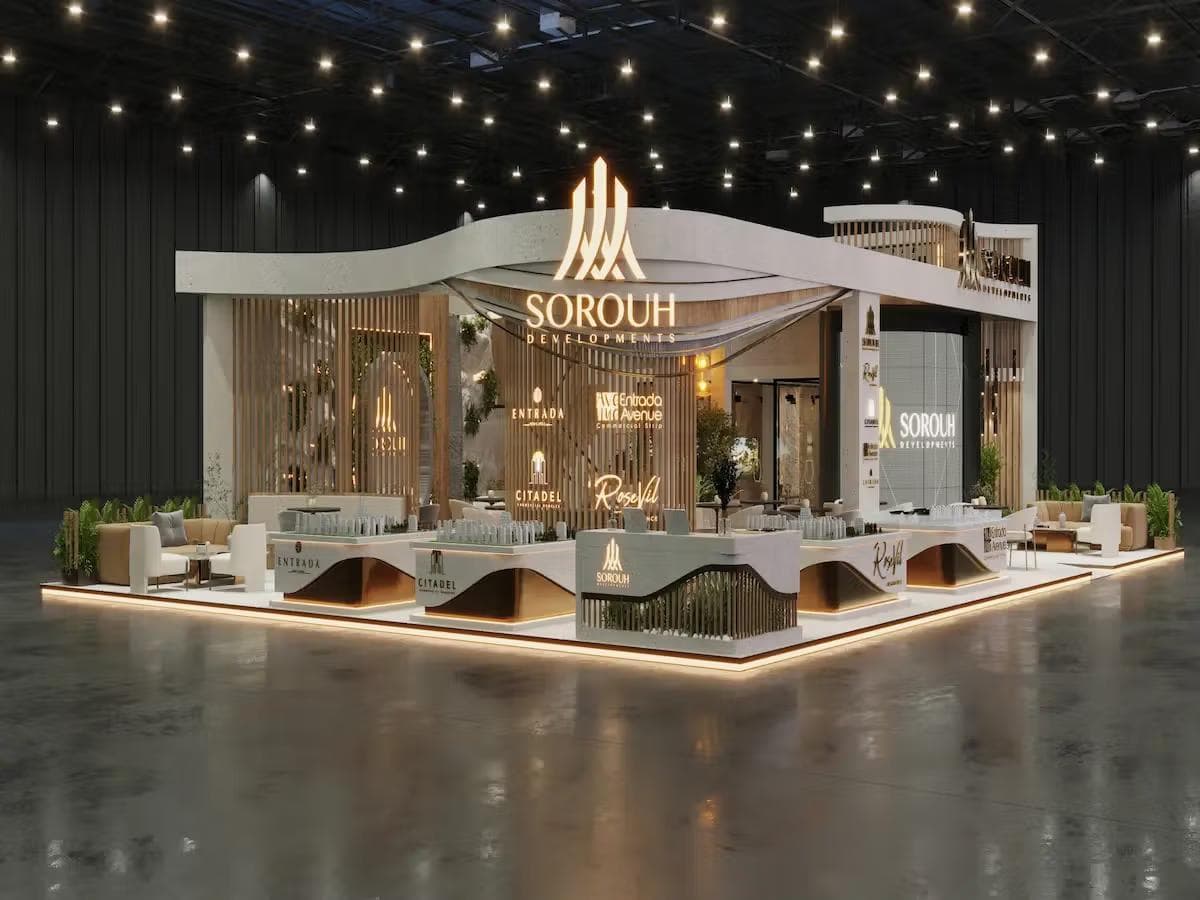
For the Sorouh project at Cityscape Egypt, Hashtag10 developed a full 3D design render that gave the client a precise view of how the stand would read across the floor. The visualisation resolved spatial layout, material finishes, and brand presence before a single component went into production. Changes were identified and confirmed at the concept stage, not during fabrication.
This matters because late-stage changes are expensive and often impossible to accommodate without affecting the build timeline. A client who approves a detailed 3D render and then requests structural modifications during fabrication is unlikely to get the stand they want on the opening day. Resolving the design fully before production begins is not a bureaucratic step. It is the thing that makes the final build match the approved concept.
What to bring to a design brief for Cityscape Egypt:
- Confirmed floor plan allocation from the show organiser (dimensions and exact location within the hall)
- Brand guidelines document or approved assets: logo files, colour palette, typography, brand imagery
- List of projects or developments to feature on the stand, with priority ranking
- Any functional requirements: number of meeting rooms, reception desk, storage, AV specifications
- Reference images from previous stands, competitor stands, or aspirational stand designs from any sector
- Timeline confirmation, specifically your approved build window at EIEC and any Cityscape Egypt contractor badge requirements already in hand
Arriving at the design consultation with this information shortens the brief-to-render timeline and reduces the revision rounds before approval.
Planning Timeline for Cityscape Egypt Exhibitors
Cityscape Egypt 2026 opens on 30 September. Working back from that date, here is the schedule that gives a custom-built exhibition stand the best chance of arriving on the floor in the condition the client approved.
The process starts in late June, when the initial brief needs to be submitted to the design team. From there, the 3D concept is developed and presented to the client by mid-July, leaving two weeks for review before design is approved and signed off in late July.
Fabrication begins in early August. While components are being built, the graphics files need to be finalised and sent to print by mid-August; printed graphics have their own production lead time and cannot wait for fabrication to finish. By mid-September, fabrication should be complete and quality-checked against the approved design.
Components ship to EIEC Cairo in the third week of September, ahead of the build window that Cityscape Egypt's organisers allocate per their official contractor schedule. Stand installation needs to be complete by 29 September, one day before the show opens.
FAQ
What is Cityscape Egypt and who exhibits there?
Cityscape Egypt is Africa's largest real estate exhibition, held annually at the Egypt International Exhibition Center in Cairo. The 2026 edition is the 15th, running from 30 September to 3 October. Exhibitors are predominantly real estate developers, urban planning companies, property investment groups, construction material suppliers, and proptech companies. The visitor profile includes investors, homebuyers, architects, government officials, and real estate professionals from Egypt, the wider North Africa region, and internationally. For real estate brands targeting Egyptian investors or launching residential and commercial projects in the Egyptian market, Cityscape Egypt is the primary exhibition platform of the year.
How much does an exhibition stand at Cityscape Egypt cost?
Stand costs at Cityscape Egypt vary significantly based on floor space allocation, stand type, construction specification, and the level of custom design involved. An inline stand for a smaller developer and a multi-level island stand for a major developer are different categories of investment. Key cost drivers include the size of the floor allocation, whether the stand requires a double-decker structure, the complexity of the 3D design, the volume of printed graphics, AV and lighting specification, and the logistics involved in delivering fabricated components to EIEC on schedule. For an accurate project quote based on your specific brief and floor allocation, contact Hashtag10 directly.
When should I start planning my exhibition stand for Cityscape Egypt?
For a custom-built stand at Cityscape Egypt, the briefing process should begin no later than late June, roughly three months before the show opens. This allows adequate time for 3D concept development, client review and approval, fabrication, graphics production, quality checking, and logistics to EIEC. Brands that begin the process in August or September typically face a choice between a reduced design specification or a compressed build timeline that affects finish quality. Starting early is not a preference. It is what makes the difference between receiving the stand you designed and receiving a stand that had to be modified to fit the time available.
What stand types work at the Egypt International Exhibition Center?
EIEC Cairo's hall configuration supports island, inline, peninsula, and double-decker stands. The stand type that works best for your brand depends on your contracted floor allocation, your budget, and your primary objectives for the show. Island stands offer maximum design freedom and visibility from multiple directions; they suit larger developers with the floor space and budget to justify them. Inline stands are the most common configuration and can be very effective with a strong front elevation. Peninsula stands offer a balance between visibility and cost. Double-decker stands create significant visual presence and add private upper-level meeting space, but require longer lead times for structural design and venue approval.
Does Hashtag10 manage the full stand design and build, or only design?
Hashtag10 manages the full process from initial brief and 3D design through fabrication and on-site installation. The design team and the production team work within the same organisation, which means the approved 3D render is the specification the fabrication team works from. There is no handover between a separate design agency and a separate contractor. For clients at Cityscape Egypt, this means that the stand installed at EIEC is built to the design the client approved, not to an approximation of it that resulted from a communication gap between design and build.
Written by Hashtag10 Team
Expert insights on exhibition design, event strategy, and creating unforgettable brand experiences.
View all articles →